

Faith Under Construction: Deconstruction, Disillusionment & a Deeper Walk with Jesus
 By Mark Warren
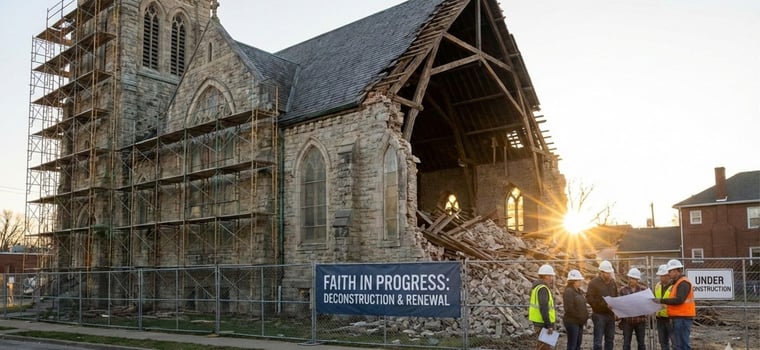
Are you questioning your faith in Jesus? Do you wonder if some church teachings are untrue, and maybe even feel repelled by the church? Do you have inner doubts but are afraid to voice them? Are you looking for a way to authentically challenge your beliefs without going down an unwanted road?
I recently had lunch with an old friend I hadn’t seen in quite a while. We were catching up on life, work, family—the usual things—when, somewhere between bites, he casually dropped a comment that caught my attention.
“I’m a deconstructionist with my faith,” he said. I’d heard the term before, but it felt broad and a little unclear. So, I asked him what he meant. He began sharing what he believes now—and where those beliefs contrast with traditional biblical views and long-held Christian teaching. The conversation stayed with me and later that night I did some reading and research, trying to understand what deconstruction really means, why so many people are walking this road, and where it often leads.
This article examines the rise of faith deconstruction within the Christian church—exploring why many believers begin questioning long-held beliefs, considering healthy ways to scrutinize teachings and encouraging the pursuit of honest answers to meaningful questions. If you consider yourself a deconstructionist or exploring it, let me say this clearly from the start: you are not broken for asking hard questions – and you are not unfaithful for wanting something real.
Contents:
- "Deconstructing Faith" Defined
- Failures of the Church
- The Difference Between the Church and Jesus
- Benefits of Healthy Deconstruction
- Dodging Traps of Deconstruction
- Tips for Productive Deconstruction
“Deconstructing Faith” Defined
It’s a word that gets whispered – or candidly proclaimed – more often these days in church conversations: "deconstruction." In a church context, deconstruction usually means pulling apart what you’ve believed to examine it more closely.
For some, the concept feels threatening. For others, relieving. For many, it simply names what they’ve already been experiencing: questions they didn’t feel allowed to ask, doubts they didn’t know how to voice, and disappointments they never expected to carry.
The process involves asking:
-
Why do I believe this?
-
Is this biblical – or just traditional?
-
Is this Jesus – or just church culture?
For many, deconstruction isn’t about rejecting Jesus. It’s about rejecting a version of Christianity that feels shallow, harsh, political, performative, or harmful. In that sense, deconstruction often begins not with rebellion, but with disillusionment. What is reassuring to understand though is that this is the kind of faith Jesus Himself confronted when He said, “this people honors me with their lips, but their heart is far from me” (Matthew 15:8, ESV).
Failures of the Church
Many people don’t walk away from Jesus – they walk away from church expressions that misalign Jesus with power, politics, perfectionism, or performance.
While the term deconstruction is modern, the idea and practice are ancient. In Old Testament time, many religious leaders misrepresented God by overburdening them with man-made laws while holding themselves to a different standard. Then, in the New Testament we see teachers upholding rules that Jesus never gave. Understandably, this hypocrisy, legalism, and controversial teaching resulted in many people rejecting their faith.
Today is no different. There are numerous pastors who have been exposed for harming others, churches who ungraciously harp on select sins, and Christian families who behave one way at church and another way at home.
[Related: I have been Hurt By Church, What do I do: A Pastor's Story]
The Difference Between the Church and Jesus
Distinguishing between the church and Jesus matters. The church is made up of broken people at various stages of spiritual maturity. And, sadly, there are people in churches masquerading as Christ-followers. Jesus warned us of this, saying, . says, "beware of false prophets, who come to you in sheep's clothing but inwardly are ravenous wolves" (Matthew 7:15, ESV).
On the other hand, Jesus is perfect, holy, faithful, genuinely loving, and unchanging. "Jesus Christ is the same yesterday and today and forever" (Hebrews 13:8, ESV). The church will fail you; Jesus will not. He wants you to bring Him all of your disappointments so you can be comforted and set free.
Benefits of Healthy Deconstruction (Yes, there are some)
We see several people in the Bible that are surprisingly honest about their doubt. David openly questioned God (see the Psalms). Job demanded answers in his suffering. Thomas doubted the resurrection. The disciples struggled to believe what Jesus was doing.
While prideful unbelief was condemned, authentic questioning was not. Closed hearts don't reach God, but He always welcomes honest wrestlers. God promises, "You will seek me and find me, when you seek me with all your heart" (Jeremiah 29:13, ESV).
When handled humbly and anchored in Christ, deconstruction can produce real spiritual fruit. It can:
• Move Faith from Inherited to Owned
Scripture consistently invites God’s people to examine their faith. Paul encourages believers to "examine yourselves, to see whether you are in the faith" (2 Corinthians 13:5, ESV).
Borrowed faith rarely survives real life. Testing what you believe forces you to decide whether your faith belongs to your parents, your pastor, your denomination—or you. A faith you’ve wrestled with is often stronger than one you’ve never examined.
• Expose Unhealthy Theology
Some beliefs don’t come from Scripture; they often come from tradition, control, or fear. Jesus regularly challenged man-made religion that obscured God’s heart, warning against teachings that "have indeed an appearance of wisdom" but lack true spiritual power (Colossians 2:23, ESV).
Deconstruction can help strip away destructive lies. Legalism dressed up as holiness. Shame disguised as discipleship. Cultural preferences masquerading as doctrine. That kind of pruning, though painful, can make room for truth to flourish.
• Create Space for Grace
A tested faith often produces humility and grace. Peter writes that trials refine faith so that it may result in "praise and glory and honor at the revelation of Jesus Christ" (1 Peter 1:6–7, ESV).
People who have questioned deeply often become more compassionate, patient, and aware of complexity. They learn that faith is not about having all the answers, but about trusting Jesus even when answers are incomplete or not fully understood.
Dodging Traps of Deconstruction
Here’s where we need to be honest. Deconstruction is not neutral. It forms us – for better or worse. It is in your best interest to consider what you are jumping into before taking the plunge. Test the waters, look around, be aware of your goal, and don't lose sight of it as you start looking around. Here are a few concepts that can help:
• Deconstruction Without Reconstruction Leaves a Vacuum
Scripture warns against tearing down without rebuilding. Jesus described the danger of an empty house—when truth is removed but nothing godly takes its place (Matthew 12:43–45, ESV). Pulling faith apart without rebuilding it on Christ leaves people spiritually homeless. When Jesus is removed instead of rediscovered, something else will take His place – politics, ideology, self, or cynicism. That is why Scripture doesn’t call us to tear down without building up.
• Pain Can Turn into Cynicism
Church hurt is real. Leadership failure is real. Hypocrisy is real. But if pain becomes our primary lens, we risk becoming controlled by it—confusing woundedness with wisdom. The writer of Hebrews cautions believers to "see to it that no root of bitterness springs up and causes trouble" (Hebrews 12:15, ESV). Cynicism at first may feel discerning, but it slowly hardens the heart and dulls spiritual sensitivity.
• Isolation Makes Deconstruction More Dangerous
Scripture consistently emphasizes the necessity of community: "Let us consider how to stir up one another to love and good works, not neglecting to meet together" (Hebrews 10:24–25, ESV).
Faith was never meant to be deconstructed alone. When people pull away from community entirely, questions often grow louder and hope grows quieter. God frequently uses the very community that disappoints us to heal us – when we stay engaged with discernment and respect.
Tips for Productive Deconstruction
There is a better way to journey through a deconstruction process. Mindful choices will help you move forward without becoming jaded – or walking away completely. Questioning faith can make you a stronger and fulfilled person when it is done with a biblical perspective. Here are some tips to help you achieve what you are after:
• Keep Jesus at the Center
The writer of Hebrews urges believers to keep their eyes fixed on Christ: "looking to Jesus, the founder and perfecter of our faith" (Hebrews 12:2, ESV).
Don’t start with what the church did wrong. Start with who Jesus is. Return to the Gospels. Watch how He treats doubters, sinners, outsiders, and religious leaders. Let Jesus correct distorted images you may have inherited.
• Separate the Gospel from Its Messengers
Paul acknowledged human weakness in ministry while pointing to God’s power, reminding the church that "we have this treasure in jars of clay" (2 Corinthians 4:7, ESV).
Bad preaching doesn’t negate good news. Misused Scripture doesn’t invalidate truth. Hold leaders accountable – but don’t let leadership failure define your theology.
• Stay in Community (Even When It’s Hard)
God designed believers to grow together as one body, where "each part is working properly" (Ephesians 4:15–16, ESV).
You don’t need a perfect church. You need a healthy one—one that welcomes questions, practices humility, and keeps Jesus central. Healing rarely happens in isolation.
[Related: 5 Signs of a Healthy Church (From a Pastor's Perspective)]
• Let Scripture, Not Social Media, Shape Your Faith
Scripture is God’s primary tool for forming mature faith: "All Scripture is breathed out by God and profitable for teaching, for reproof, for correction, and for training in righteousness" (2 Timothy 3:16–17, ESV).
Many people deconstruct with podcasts, posts, and influencers—but never rebuild with Scripture. If your questions and the opinions of others are louder than God’s Word, your faith will drift.
• Allow God to Redeem the Pain
God’s redemptive purpose extends even to suffering. Paul reminds us that "this light momentary affliction is preparing for us an eternal weight of glory beyond all comparison" (2 Corinthians 4:17, ESV).
God wastes nothing – not even disappointment. Wounds can deepen you when you seek God's comfort. Confusion can refine you when you search God's Word. What nearly broke your faith can become the very place where it matures.
[Related: Why Trusting God is so Hard: A Survivor's Journey of Fear and Faith]
Takeaway
Rather than cheering the collapse of faith or being shamed back into silence, give yourself the liberty to honestly voice your questions, doubts, and disappointments; and the self-respect to not let others (on either side of the pendulum) decide for you but to make your own decision Deconstruction done Scripturally brings better results than unquestioning faith. The goal isn’t blind belief; the goal is anchored trust.
A faith that:
-
Is humble enough to ask questions
-
Strong enough to withstand disappointment
-
Deep enough to survive suffering
-
Rooted enough to stay when walking away feels easier
Jesus never promised an easy faith – but He did promise His presence: "I am with you always, to the end of the age" (Matthew 28:20, ESV). A faith built on Him, not the shifting perspectives of people, will last. If your faith feels under construction, take heart. God isn’t afraid of the mess. He’s not done building yet. The results can be far better than going with the flow. The process, when it is healthy, leads to a faith that is honest, resilient, rooted in Jesus, and not easily shaken by church failure or cultural pressure—a faith built on the solid foundation of Christ (Matthew 7:24–25, ESV).
We'd love to hear from you if we can help in your faith journey!
Related Articles:
- 7 of Jesus' Liberating Teachings that Make Legalistic Christian Squirm
- 7 Fulfilled Prophecies to Discover or Increase Confidence in Christ
- What Jesus' Miracles Reveal About Him (7 Faith Building Stories)
- Can I Know God Personally? (5 Ways to Encounter & Grow Closer to God)
- What does it mean to be saved by Jesus? An Uncomplicated Explanation
- The Basics of What Christians Believe (radically simple but profound)
- Does Prayer Really Work? (10 Secrets to Effective Prayer)
- Who Should I Pray To? (Comparing gods from the Top 5 Religions)
- How to Read the Bible Using the S.O.A.P. Method
- How to Pick a Book of the Bible to Read (grow closer to God & thrive)
- 6 Tips for Choosing the Right Church For You
Are you looking for a church in the Concord, NH area? We invite you to join us in-person or online. Grace Capital Church is located at 542 Pembroke Street in Pembroke, NH.


-1.jpg?width=310&height=230&name=Baptism%20(1)-1.jpg)
Comments